Tutorial
In this tutorial we demonstrate how to fit a function to data using both a maximum-likelihood method, and by running a
MCMC using the roxy module. We then plot our results.
To start with, we call functions with the argument method='mnr'
as this is the simplest recommended likelihood for data with x and y errors and if you infer intrinsic scatter,
however this can be replaced with method='unif'
for an infinite uniform prior on the true x values, or method='prof' to use the profile likelihood.
In the presence of x-errors, the profile method is accurate in the absence of intrinsic scatter and the
unif method able to recover intrinsic scatter, however MNR is the only method that is approximately unbiased in all the regression parameters.
In summary, you should use the following likelihoods in the following situations:
If you have \(x\) and \(y\) errors and DO wish to infer intrinsic scatter: use
method='mnr'.If you have \(x\) and \(y\) errors and DO NOT wish to infer intrinsic scatter: use
method='prof'.If you only have \(y\) errors: use
method='prof'ormethod='unif'(they are identical in this case).
Next, we show how to extend the MNR method to a sum of Gaussians using the argument
method='gmm'.
Given that the user will not know whether more than one Gaussian is appropriate a priori, we recommend
going through this section and applying these methods to your dataset. We leave this to the end of the
tutorial, however, so that you can get used to roxy’s features before worrying about the choice
of likelihood.
Please see the MNR paper for more details on these likelihoods and their advantages/disadvantages.
We provide a note about the reproducibility of the tutorial results at the end of the tutorial.
Defining our function
We begin by defining a function which we wish to fit. Here we have my_fun, which is simply a straight line, but more complicated functions can be chosen. The function must take two arguments, the first being the independent variable, and the second are the parameters of interest.
import matplotlib.pyplot as plt
import numpy as np
from roxy.regressor import RoxyRegressor
import roxy.plotting

def my_fun(x, theta):
    return theta[0] * x + theta[1]
The optimisation and MCMC functionality of roxy can be accessed by the roxy.regressor.RoxyRegressor class, which we define here.
We must supply the names of each of the parameters of my_fun, as well as a fiducial point and the range of the priors (as a dictionary). We assume uniform priors for all parameters.
If you wish to set improper uniform priors without edges on an parameter, simply include None in one of the entries of the prior for that parameter.
param_names = ['A', 'B']
theta0 = [2, 0.5]
param_prior = {'A':[0, 5], 'B':[-2, 2], 'sig':[0, 3.0]}

reg = RoxyRegressor(my_fun, param_names, theta0, param_prior)
Mock data generation
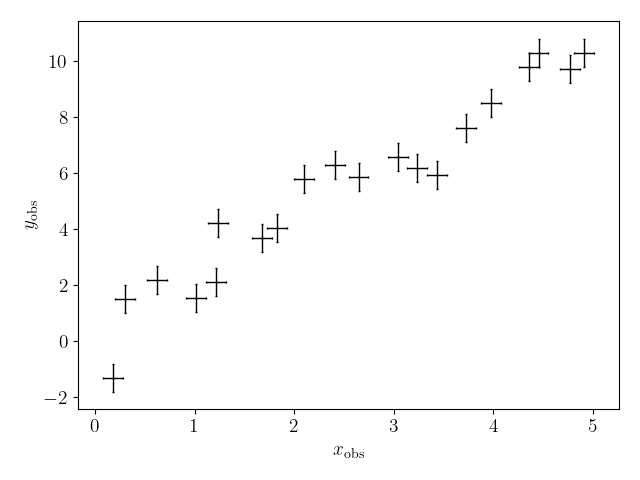
Let us make some mock data from this function
nx = 20
xerr = 0.1
yerr = 0.5
sig = 0.5

np.random.seed(0)

xtrue = np.linspace(0, 5, nx)
ytrue = reg.value(xtrue, theta0)
xobs = xtrue + np.random.normal(size=len(xtrue)) * xerr
yobs = ytrue + np.random.normal(size=len(xtrue)) * np.sqrt(yerr ** 2 + sig ** 2)

plot_kwargs = {'fmt':'.', 'markersize':1, 'zorder':1,
                 'capsize':1, 'elinewidth':1.0, 'color':'k', 'alpha':1}
plt.errorbar(xobs, yobs, xerr=xerr, yerr=yerr, **plot_kwargs)
plt.xlabel(r'$x_{\rm obs}$', fontsize=14)
plt.ylabel(r'$y_{\rm obs}$', fontsize=14)
plt.tight_layout()
Maximum likelihood estimation
We begin by finding the maximum likelihood point, which is as simple as
res, all_param_names = reg.optimise(param_names, xobs, yobs, [xerr, yerr], method='mnr')
Optimisation Results:
A:      2.085973024368286
B:      0.20573419332504272
sig:    0.6321122646331787
Note that res here is a scipy.optimize._optimize.OptimizeResult object, so you can use all the usual functionality this contains.
In this example, we optimised all the parameters. If, instead, we just wished to only find the gradient,
we could have used ['A'] instead of param_names, and then the intercept would be fixed to the default value in
theta0 which we gave when initialising the regressor object (so in this case 0.5). We can also choose
to assume no intrinsic scatter by using the argument infer_intrinsic=False when calling reg.optimise.
Markov chain Monte Carlo
We will now run a MCMC. This uses the NUTS sampler from numpyro which is incredibly fast. We choose to use 700 warmup steps and take 5000 samples. We see that the result reports 3613.66 iterations per second, so this MCMC takes less than 2 seconds to run!
We print the parameter mean and median values, their standard deviations, the 5% and 95% bounds, the number of effective samples and the Gelman-Rubin statistic.
nwarm, nsamp = 700, 5000
samples = reg.mcmc(param_names, xobs, yobs, [xerr, yerr], nwarm, nsamp, method='mnr')
Running MCMC
sample: 100%|█████████████████████████████| 5700/5700 [00:02<00:00, 2665.71it/s, 15 steps of size 3.42e-01. acc. prob=0.91]

                mean       std    median      2.5%     97.5%     n_eff     r_hat
         A      2.09      0.14      2.10      1.80      2.38   2221.65      1.00
         B      0.19      0.43      0.18     -0.65      1.06   2116.94      1.00
  mu_gauss      2.56      0.36      2.56      1.83      3.24   3358.24      1.00
       sig      0.74      0.22      0.73      0.36      1.19   2870.27      1.00
   w_gauss      1.63      0.29      1.59      1.11      2.18   3327.07      1.00

Number of divergences: 0
In this example we chose to use method='mnr', but this can be any one of ‘mnr’, ‘gmm’, ‘unif’ or ‘prof’. See roxy.likelihoods and the MNR paper for more details of the choice of likelihood.
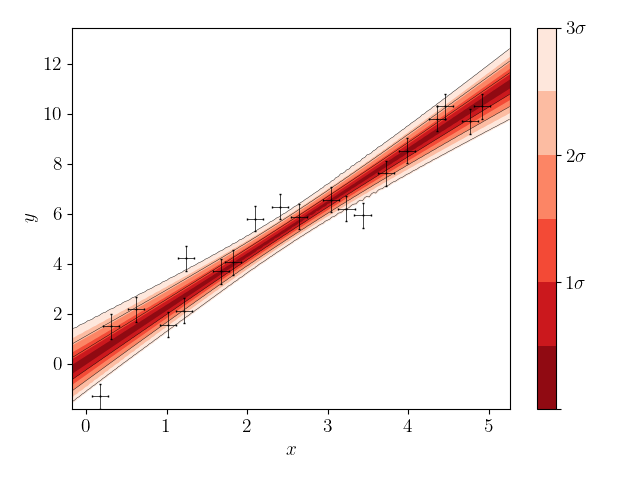
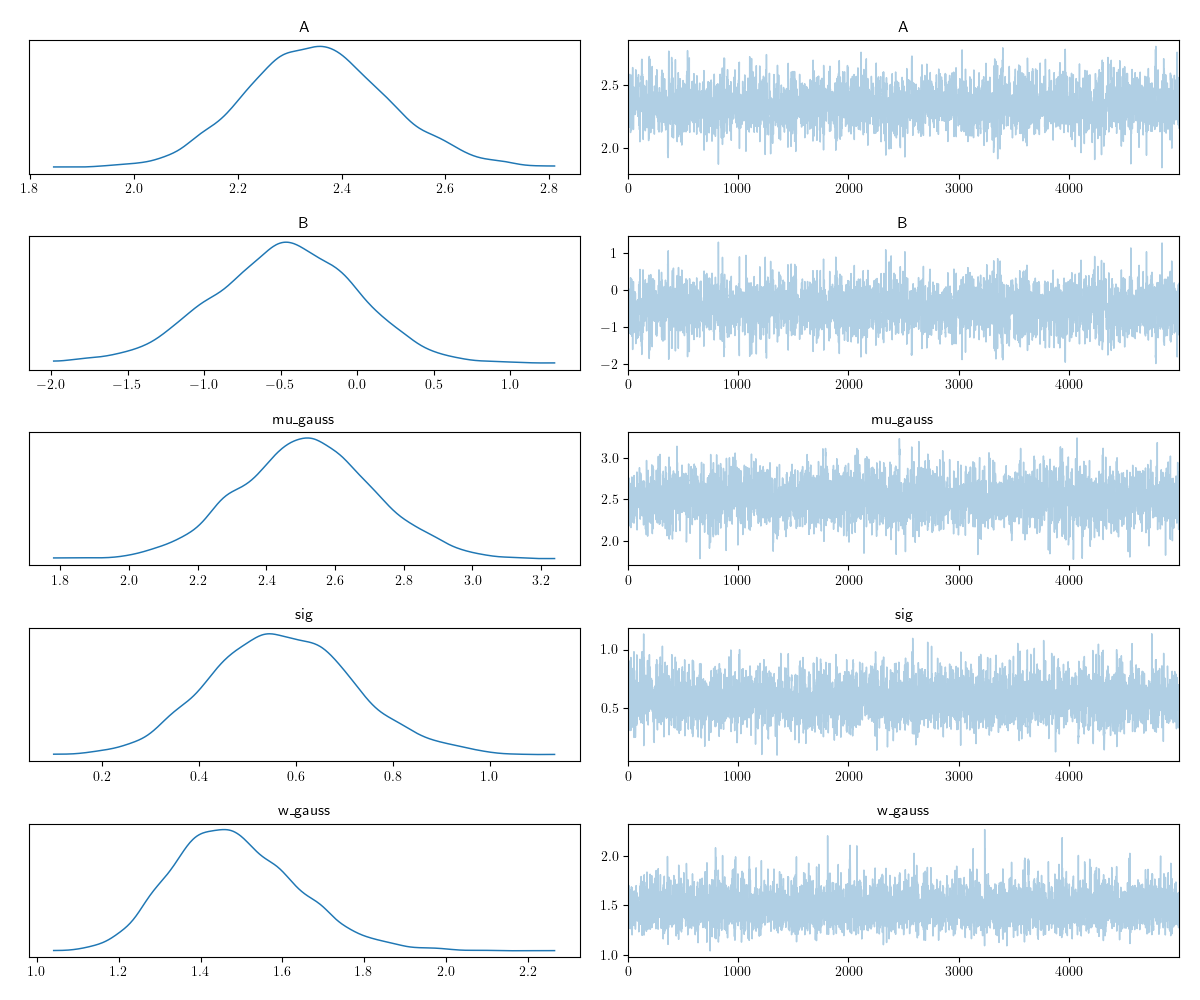
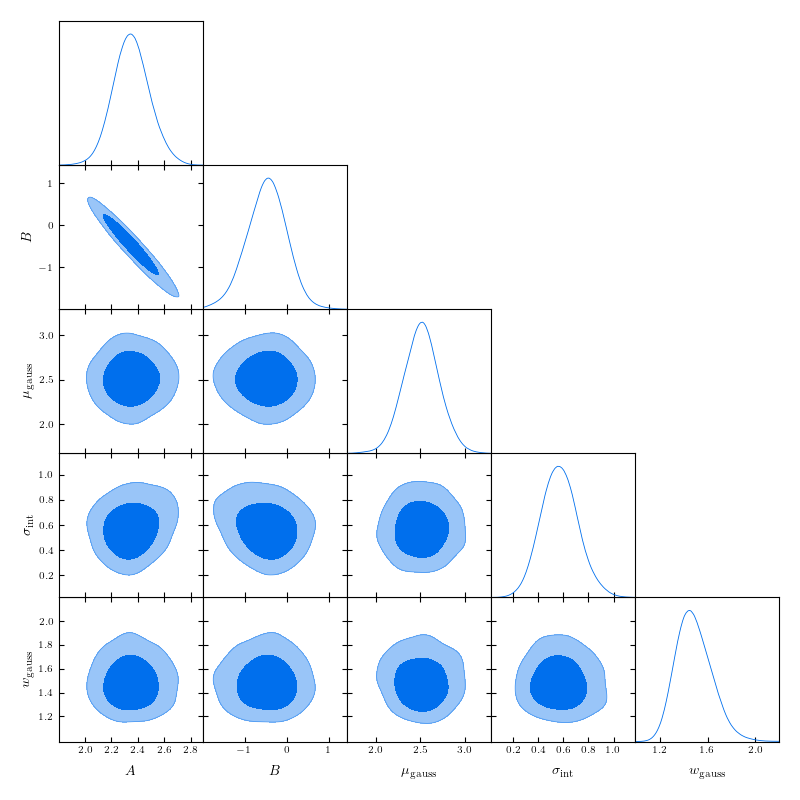
We now plot the results. The trace plot gives the sample value as a function of MCMC step, the triangle plot gives the one- and two-dimensional posterior distributions, and the posterior predictive plot gives the predicted function values at 1, 2 and 3 sigma confidence.
These plots make use of the arviz, getdist and fgivenx modules, respectively. We also have functionality to produce triangle plots with the corner module (by replacing module='getdist' with module='corner' in roxy.plotting.triangle_plot).
roxy.plotting.trace_plot(samples, to_plot='all')
roxy.plotting.triangle_plot(samples, to_plot='all', module='getdist', param_prior=param_prior)
roxy.plotting.posterior_predictive_plot(reg, samples, xobs, yobs, xerr, yerr)


Again, in this case we sampled all the parameters. If, instead, we just wished to just sample the gradient,
we could have passed ['A'] for param_names, and then the intercept would be fixed to the default value in
theta0 which we gave when initialising the regressor object (so in this case 0.5). We can also choose
to assume no intrinsic scatter by using the argument infer_intrinsic=False when calling reg.mcmc.
Gaussian Mixture Models
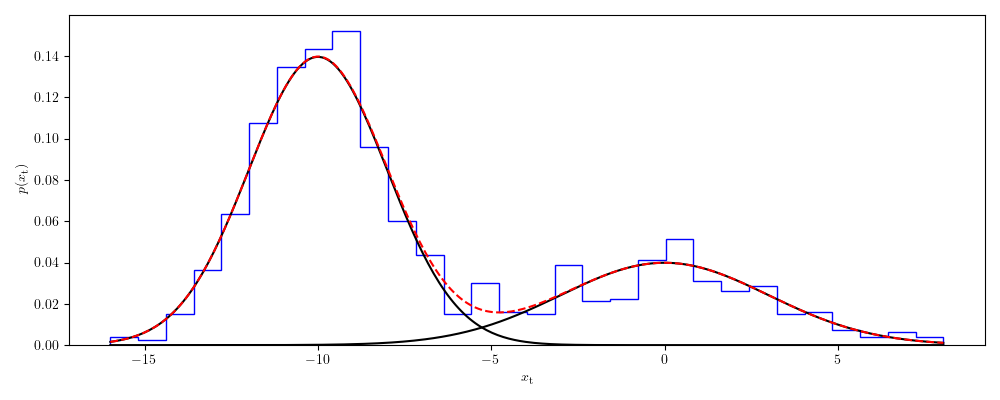
We now consider a case where a single Gaussian is not sufficient to characterise the distribution of the true x values, and so we resort to a Gaussian mixture model. In the MNR paper we study the effect of using multiple Gaussians and find that it can sometimes reduce biases. In this case we must fit the distribution
where we have a set of weights, means a variances which we must fit. This can be achieved by using method='gmm' in roxy functions.
As an example, let us create some mock data from a two-component Gaussian mixture
import numpy as np

np.random.seed(0)

nx = 1000

# Draw the samples from a two Gaussian model
true_weights = np.array([0.7, 0.3])
true_means = [-10.0, 0.0]
true_w = [2, 3]

which_gauss = np.random.uniform(0, 1, nx)
p = np.array([0] + list(true_weights))
p = np.cumsum(p)
xtrue = np.empty(nx)
for i in range(len(true_means)):
    m = (which_gauss >= p[i]) & (which_gauss < p[i+1])
    print(i, m.sum())
    xtrue[m] = np.random.normal(true_means[i], true_w[i], m.sum())
Plotting the distribution, we see this is highly non-Gaussian
import matplotlib.pyplot as plt
import matplotlib as mpl
mpl.rcParams['text.usetex'] = True

fig, ax = plt.subplots(1, 1, figsize=(10,4))
ax.hist(xtrue, bins=30, density=True, histtype='step', color='b')
x = np.linspace(xtrue.min(), xtrue.max(), 300)
ysum = np.zeros(len(x))
for nu, mu, w in zip(true_weights, true_means, true_w):
    y = nu / np.sqrt(2 * np.pi * w ** 2) * np.exp(- (x - mu) ** 2 / (2 * w ** 2))
    ysum += y
    ax.plot(x, y, color='k')
ax.plot(x, ysum, color='r', ls='--')
ax.set_xlabel(r'$x_{\rm t}$')
ax.set_ylabel(r'$p(x_{\rm t})$')
fig.tight_layout()
plt.show()
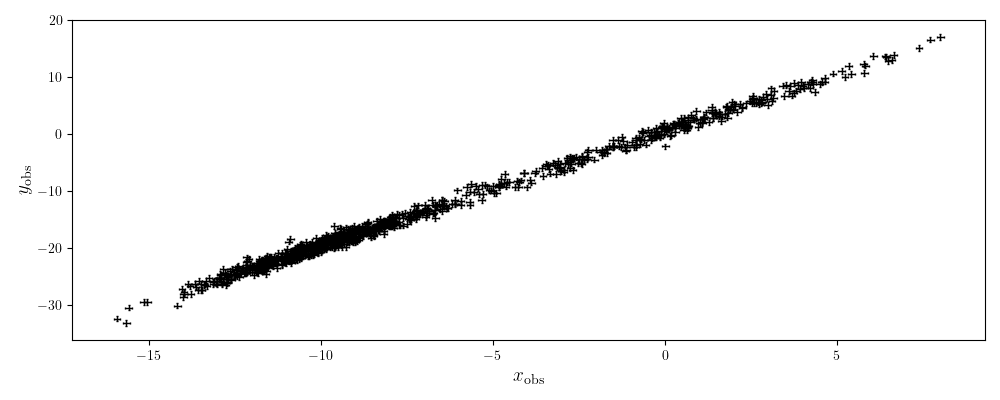
We then (as before) assume that these data given rise to y values which obey a straight line, so create mock data
from roxy.regressor import RoxyRegressor

def my_fun(x, theta):
    return theta[0] * x + theta[1]

param_names = ['A', 'B']
theta0 = [2, 0.5]
param_prior = {'A':[0, 5], 'B':[-2, 2], 'sig':[0, 3.0]}
xerr = 0.1
yerr = 0.5
sig = 0.5

reg = RoxyRegressor(my_fun, param_names, theta0, param_prior)

ytrue = reg.value(xtrue, theta0)
xobs = xtrue + np.random.normal(size=len(xtrue)) * xerr
yobs = ytrue + np.random.normal(size=len(xtrue)) * np.sqrt(yerr ** 2 + sig ** 2)
Which we then plot
plot_kwargs = {'fmt':'.', 'markersize':1, 'zorder':1,
         'capsize':1, 'elinewidth':1.0, 'color':'k', 'alpha':1}
plt.errorbar(xobs, yobs, xerr=xerr, yerr=yerr, **plot_kwargs)
plt.xlabel(r'$x_{\rm obs}$', fontsize=14)
plt.ylabel(r'$y_{\rm obs}$', fontsize=14)
plt.tight_layout()
plt.show()
Finally, we can run the same functions as before but with the method='gmm' argument to optimise or run a MCMC.
Note that we have to use the argument ngauss=2 if we want to fit using two Gaussians.
We need to choose a prior for the parameters of the GMM, which is controlled by the argument gmm_prior.
If you use gmm_prior='uniform', then a uniform prior is placed on the means and widths of the GMM componenets.
Instead if you use gmm_prior='hierarchical', then the means and width have a Gaussian and Inverse Gamma prior, respectively. The hyper-parameters controlling these priors are drawn from Uniform or Inverse Gamma distributions (see the paper for more details).
This introduces
three further parameters which specify the priors, which we also have to sample.
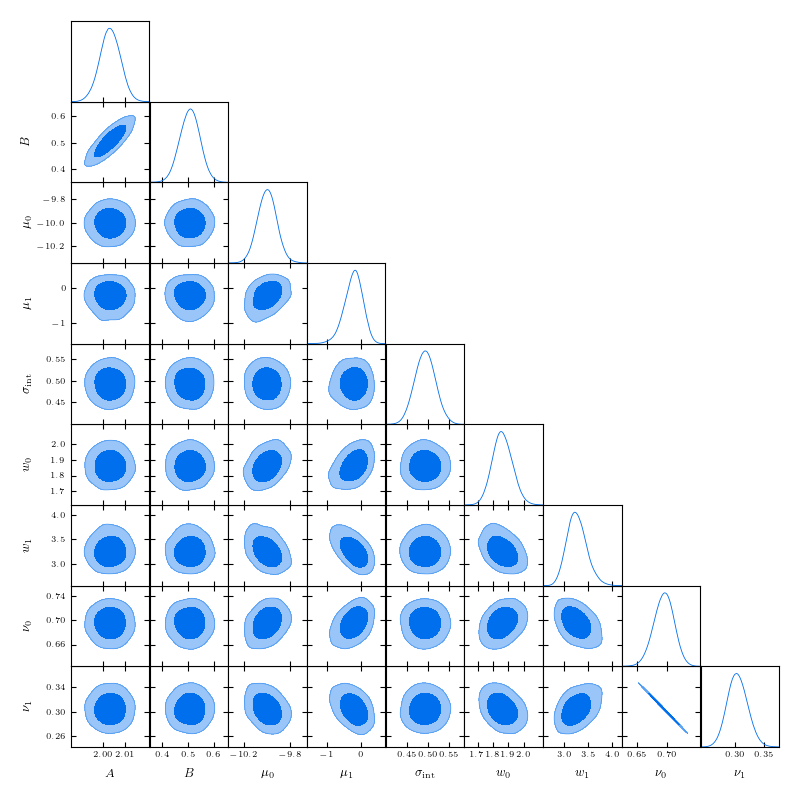
For example, running
import roxy.plotting

nwarm, nsamp = 700, 5000
samples = reg.mcmc(param_names, xobs, yobs, [xerr, yerr], nwarm, nsamp, method='gmm', ngauss=2, gmm_prior='uniform')
roxy.plotting.triangle_plot(samples, to_plot='all', module='getdist', param_prior=param_prior, show=True)
yields
Running MCMC
sample: 100%|██████████████████████████████| 5700/5700 [00:06<00:00, 898.22it/s, 15 steps of size 3.22e-01. acc. prob=0.94]

                 mean       std    median      2.5%     97.5%     n_eff     r_hat
          A      2.00      0.00      2.00      1.99      2.01   4206.88      1.00
          B      0.51      0.04      0.51      0.43      0.58   3916.77      1.00
mu_gauss[0]    -10.00      0.08    -10.00    -10.17     -9.85   3809.84      1.00
mu_gauss[1]     -0.22      0.27     -0.20     -0.78      0.28   3374.51      1.00
        sig      0.49      0.02      0.49      0.45      0.54   4462.18      1.00
 w_gauss[0]      1.86      0.06      1.86      1.73      1.99   3811.61      1.00
 w_gauss[1]      3.26      0.21      3.25      2.87      3.68   3498.38      1.00
 weights[0]      0.70      0.02      0.70      0.66      0.73   4183.47      1.00
 weights[1]      0.30      0.02      0.30      0.27      0.34   4183.47      1.00

Number of divergences: 0
and
A priori, we may not know how many Gaussians to use. For this case, we provide a function find_best_gmm as part of the
roxy.RoxyRegressor class, which can iterate through some number of Gaussians, and compare the best through either the
AIC or BIC. For example, with these data, we can check to see whether we should use 1, 2 or 3 Gaussians
max_ngauss = 3
np.random.seed(42)
reg.find_best_gmm(param_names, xobs, yobs, xerr, yerr, max_ngauss, best_metric='BIC', nwarm=100, nsamp=100, gmm_prior='uniform')
which gives (alongside some other output)
Best ngauss according to BIC: 2
1 555.8955078125
2 0.0
3 22.76904296875
so, indeed, 2 Gaussians are preferred.
Note that we specified nwarm and nsamp. This is because we run a short MCMC at each parameter optimisation step
to give us a better initial starting point to run our optimiser. These values can be set to small numbers, as we do not
care about sampling the distribution well, but only getting a good initial guess.
Direction of causality
A property of the likelihoods used in roxy is asymmetry with respect to \(x\) and \(y\),
so that the regression results depend on which variable is considered independent.
The result is most reliable when the direction of regression matches the direction of causality in the system under investigation.
This may be assessed by treating the scatter of the points around the best-fit line as an additive noise model.
In this case, the independent variable may be identified as the one that has least correlation with the residuals of the fit.
The roxy function roxy.causality.assess_causality fits both the forward and inverse relations to the dataset,
produces plots of the data in both directions with both regression models overlaid and the corresponding normalised
residuals plotted against the independent variable, and calculates a correlation coefficient (Spearman, Pearson or HSIC).
The default choice is HSIC (Hilbert-Schmidt Independence Criterion) because this was used in the original paper
(Hoyer et al. 2008)
introducing the additive noise model.
This method has been shown to be highly reliable
(Mooij et al. 2014).
From these coefficients roxy makes a recommendation as to which variable to treat as independent and which dependent
(which may require renaming the input arrays before performing the regression).
We normalise the residuals by the square root of the
sum of the dependent variable’s error squared and the intrinsic scatter squared
so that the results are not dominated by points with large uncertainties.
For example, let us create some mock data in the case where we know that \(y\) is the dependent variable.
import numpy as np
from roxy.regressor import RoxyRegressor

def my_fun(x, theta):
    return theta[0] * x + theta[1]

param_names = ['A', 'B']
theta0 = [0.4, 1.0]
param_prior = {'A':[0, 5], 'B':[-2, 2], 'sig':[0, 3.0]}

reg = RoxyRegressor(my_fun, param_names, theta0, param_prior)

nx = 100
xerr = np.random.normal(1, 0.2, nx)
yerr = np.random.normal(2, 0.2, nx)
xerr[xerr<0]=0
yerr[yerr<0]=0
sig = 3.0

np.random.seed(0)

xtrue = np.random.uniform(0, 30, nx)
ytrue = reg.value(xtrue, theta0)
xobs = xtrue + np.random.normal(size=len(xtrue)) * xerr
yobs = ytrue + np.random.normal(size=len(xtrue)) * np.sqrt(yerr ** 2 + sig ** 2)
To do the inverse fits, we need to define the inverse function. I.e. if my_fun above gives
\(y = f(x, \theta)\), then we need the function \(x = g(y, \theta)\), which for this case is
def fun_inv(y, theta):
    return y / theta[0] - theta[1] / theta[0]
We now call the function roxy.causality.assess_causality
import roxy.causality
roxy.causality.assess_causality(my_fun, fun_inv, xobs, yobs, [xerr, yerr],
                                param_names, theta0, param_prior, method='mnr',
                                criterion='hsic')
which gives the output
Fitting y vs x

Optimisation Results:
A:      0.38329729437828064
B:      0.6116797924041748
sig:    2.8931143283843994
mu_gauss:       14.385257720947266
w_gauss:        8.616861343383789

Fitting x vs y

Optimisation Results:
A:      1.9811209440231323
B:      2.0
sig:    3.0
mu_gauss:       6.214134216308594
w_gauss:        4.011857032775879

y(x) forward HSIC: 0.159, (p=0.898)

y(x) inverse HSIC: 0.655, (p=0.03)

x(y) forward HSIC: 0.772, (p=0.005)

x(y) inverse HSIC: 2.342, (p<0.001)

Recommended direction: y(x)
and the figure
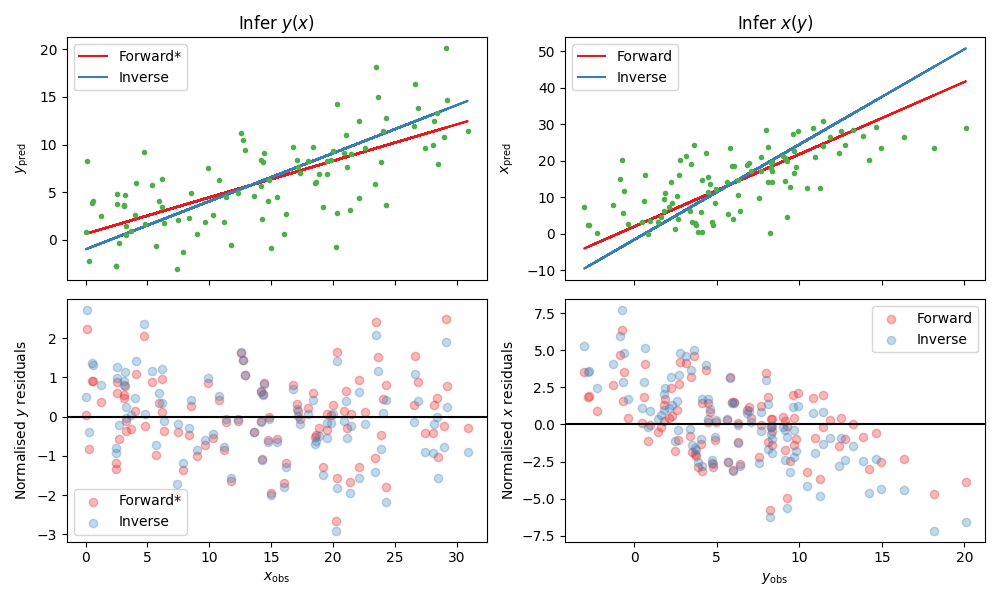
From the correlation coefficients, we see that fitting \(y(x)\) in the forward direction is the best option, and thus in the plot this option is starred (and is correct). We caution however that the correlations may be non-monotonic and/or nonlinear, and therefore recommend picking the regression direction that visually produces the lowest correlation in the residuals, only resorting to the quantitative correlation coefficients in close cases. We also caution that the test is more accurate the larger \(\sigma_{\rm int}^2 + \sigma_y^2\) is relative to \(\sigma_x^2\), and may be unreliable in the opposite regime.
Fitting with Upper Limits
We now consider the case where some of our data points are upper limits (i.e., censored data).
This happens, for example, when an instrument has a certain detection threshold, and any
measurement below that threshold is not detected and is instead reported as an upper limit.
The roxy module can handle upper limits in the independent variable (yobs) by passing the
argument y_is_detected. This is an array of booleans of the same length as yobs,
indicating whether each data point is detected (True) or an upper limit (False).
By default, all data points are assumed to be detected.
So far, we have only implemented this functionality for the MNR likelihood, so you must use
method='mnr' when calling the relevant functions.
In this case, the likelihood is modified to account for the censored data points.
An example is given below.
import numpy as np
from roxy.regressor import RoxyRegressor
import roxy.plotting as plotting

np.random.seed(0)

def my_fun(x, theta):
    return theta[0] * x + theta[1]

param_names = ['A', 'B']
theta0 = [2, 0.5]
param_prior = {'A':[0, 5], 'B':[-2, 2], 'sig':[0, 3.0]}

reg = RoxyRegressor(my_fun, param_names, theta0, param_prior)

nx = 50
xerr = 0.1
yerr = 0.5
sig = 0.8

xtrue = np.linspace(0, 5, nx)
ytrue = reg.value(xtrue, theta0)

xobs = xtrue + np.random.normal(size=len(xtrue)) * xerr
yobs = ytrue + np.random.normal(size=len(xtrue)) * np.sqrt(yerr ** 2 + sig ** 2)

det_threshold = 4.0

# mask = True where value is an *upper limit* / censored
mask = yobs <= det_threshold

# Replace censored yobs with the threshold (no in-place assignment)
yobs = np.where(mask, det_threshold, yobs)

# Detection flag: True if detected, False if upper-limit
y_is_detected = ~mask

nwarm, nsamp = 700, 5000
samples = reg.mcmc(param_names, xobs, yobs, [xerr, yerr], nwarm, nsamp,
                   method='mnr', y_is_detected=y_is_detected)

plotting.trace_plot(samples, to_plot='all')
plotting.triangle_plot(samples, to_plot='all', module='getdist', param_prior=param_prior)
Optimisation Results:
A:      2.3444559574127197
B:      -0.4485660791397095
sig:    0.5253092646598816
mu_gauss:       2.514636516571045
w_gauss:        1.4311318397521973

Running MCMC
sample: 100%|██████████| 5700/5700 [00:07<00:00, 715.31it/s, 31 steps of size 2.02e-01. acc. prob=0.91]

                mean       std    median      2.5%     97.5%     n_eff     r_hat
         A      2.35      0.14      2.35      2.10      2.63   2291.15      1.00
         B     -0.48      0.48     -0.47     -1.43      0.43   2309.41      1.00
  mu_gauss      2.51      0.20      2.52      2.11      2.90   3283.05      1.00
       sig      0.57      0.15      0.57      0.28      0.86   3340.44      1.00
   w_gauss      1.48      0.15      1.47      1.19      1.77   4024.05      1.00

Number of divergences: 0
Reproducibility
This tutorial was run using MacOS with a M2 chip. We have found that the results reported can
marginally vary between architectures or between package versions of the dependenices of roxy.
Such changes are small, e.g. the fourth decimal place of an optimisation result may differ,
so if there are minor differences between the above results and what you find, there is no reason
to be concerned! For completeness, below we give the exact conda environment we used to obtain these
results.
name: roxy_env
channels:
  - conda-forge
  - defaults
dependencies:
  - bzip2=1.0.8=h0d85af4_4
  - c-ares=1.20.1=h10d778d_0
  - ca-certificates=2023.7.22=h8857fd0_0
  - importlib-metadata=6.8.0=pyha770c72_0
  - importlib_metadata=6.8.0=hd8ed1ab_0
  - jax=0.4.16=pyhd8ed1ab_0
  - jaxlib=0.4.14=cpu_py311hb9eea52_1
  - libabseil=20230802.1=cxx17_h048a20a_0
  - libblas=3.9.0=18_osx64_openblas
  - libcblas=3.9.0=18_osx64_openblas
  - libcxx=16.0.6=hd57cbcb_0
  - libexpat=2.5.0=hf0c8a7f_1
  - libffi=3.4.2=h0d85af4_5
  - libgfortran=5.0.0=13_2_0_h97931a8_1
  - libgfortran5=13.2.0=h2873a65_1
  - libgrpc=1.58.1=hecc90c7_2
  - liblapack=3.9.0=18_osx64_openblas
  - libopenblas=0.3.24=openmp_h48a4ad5_0
  - libprotobuf=4.24.3=he0c2237_1
  - libre2-11=2023.06.02=h4694dbf_0
  - libsqlite=3.43.2=h92b6c6a_0
  - libzlib=1.2.13=h8a1eda9_5
  - llvm-openmp=17.0.2=hff08bdf_0
  - ml_dtypes=0.3.1=py311h1eadf79_1
  - ncurses=6.4=hf0c8a7f_0
  - numpy=1.26.0=py311hc44ba51_0
  - openssl=3.1.3=h8a1eda9_0
  - opt-einsum=3.3.0=hd8ed1ab_2
  - opt_einsum=3.3.0=pyhc1e730c_2
  - pip=23.2.1=pyhd8ed1ab_0
  - python=3.11.4=h30d4d87_0_cpython
  - python_abi=3.11=4_cp311
  - re2=2023.06.02=hd34609a_0
  - readline=8.2=h9e318b2_1
  - scipy=1.11.3=py311h16c3c4d_1
  - setuptools=68.2.2=pyhd8ed1ab_0
  - tk=8.6.13=hef22860_0
  - wheel=0.41.2=pyhd8ed1ab_0
  - xz=5.2.6=h775f41a_0
  - zipp=3.17.0=pyhd8ed1ab_0
  - pip:
      - alabaster==0.7.13
      - arviz==0.16.1
      - babel==2.13.0
      - certifi==2023.7.22
      - charset-normalizer==3.3.0
      - contourpy==1.1.1
      - corner==2.2.2
      - cycler==0.12.1
      - docutils==0.18.1
      - fgivenx==2.4.2
      - fonttools==4.43.1
      - getdist==1.4.5
      - h5netcdf==1.2.0
      - h5py==3.10.0
      - idna==3.4
      - imagesize==1.4.1
      - jaxopt==0.8.1
      - jinja2==3.1.2
      - joblib==1.3.2
      - kiwisolver==1.4.5
      - markdown-it-py==3.0.0
      - markupsafe==2.1.3
      - matplotlib==3.8.0
      - mdit-py-plugins==0.4.0
      - mdurl==0.1.2
      - multipledispatch==1.0.0
      - myst-parser==2.0.0
      - numpyro==0.13.2
      - packaging==23.2
      - pandas==2.1.1
      - pillow==10.0.1
      - prettytable==3.9.0
      - pygments==2.16.1
      - pyparsing==3.1.1
      - python-dateutil==2.8.2
      - pytz==2023.3.post1
      - pyyaml==6.0.1
      - requests==2.31.0
      - scikit-learn==1.3.1
      - six==1.16.0
      - snowballstemmer==2.2.0
      - sphinx==7.2.6
      - sphinx-rtd-theme==1.3.0
      - sphinxcontrib-applehelp==1.0.7
      - sphinxcontrib-devhelp==1.0.5
      - sphinxcontrib-htmlhelp==2.0.4
      - sphinxcontrib-jquery==4.1
      - sphinxcontrib-jsmath==1.0.1
      - sphinxcontrib-qthelp==1.0.6
      - sphinxcontrib-serializinghtml==1.1.9
      - threadpoolctl==3.2.0
      - tqdm==4.66.1
      - typing-extensions==4.8.0
      - tzdata==2023.3
      - urllib3==2.0.6
      - wcwidth==0.2.8
      - xarray==2023.9.0
      - xarray-einstats==0.6.0